 Uniswap
 swap fees require quote checks and cost reconciliation
Uniswap swap fees are only one part of the amount a trader gives up to receive the output token. Before authorizing a swap, compare the input amount, quoted output, minimum output, pool fee, price impact, route, and estimated network cost. The exchange calculation reflects the pool fee, while the network cost is a separate payment for processing. Price impact changes the quoted rate, and slippage protection sets an execution boundary rather than adding a charge. After confirmation, reconcile the successful receipt, actual token movements, and network fee. A prior approval may add another network cost, and a token contract or selected route may impose a separate charge.
Updated
The short version: Before wallet authorization, compare quoted output, minimum output, route charges, and estimated network cost.
Cost Stages From Quote to Settlement
Quoted output incorporates the proposed route, pool fees, and simulated pool conditions. The interface also estimates the network cost and identifies the minimum output or maximum input that constrains execution. These values form a snapshot, not a permanent rate, because liquidity, routing, dynamic fees, and network demand can change before authorization.
When the swap reaches its route, it executes against the available pool state and must remain within the signed limits. A confirmed receipt then reveals whether the swap succeeded, how much the network charged, and which token movements occurred. Keeping the quote, execution record, and final balances separate prevents an estimate from being mistaken for a settled cost.
Pool Fee Rules Across Protocol Versions
The protocol version determines how a pool configures its swap fee. Uniswap v2 pools charge a fixed 0.30% swap fee. Uniswap v3 supports pools with different fee tiers, so the selected pool and route determine the applicable rate. The fee comes from the amount entering a pool and affects the output that the route can deliver.
Uniswap v4 allows static fees and hook-controlled dynamic fees. A dynamic fee can change between quotes or from one swap to another under the hook’s rules. The live route details therefore matter more than a remembered rate.
A protocol fee, where enabled, redirects part of the existing pool fee to the protocol. It does not automatically stack a second pool charge on top of the displayed swap fee. The allocation changes who receives the fee; the route quote already reflects the total trader-facing swap fee.
Price Impact, Slippage, and Output Bounds
Price impact reduces quoted output because the trade itself moves through available pool liquidity. A larger request relative to usable liquidity generally moves the pool price farther. Slippage describes the difference between an expected execution price and the price available when the swap executes. Neither term is another pool fee, although both can affect how much output reaches the wallet.
For an exact-input request, the minimum output records the lowest result that the signed request will accept. For an exact-output request, the maximum input limits how much may be spent. Widening a slippage setting does not lower the pool fee; it permits a less favorable execution before the request must revert. A fresh quote is appropriate after a material delay or a change to the amount, route, or output constraint.
Routing and Effective Exchange Cost
Routing determines which pools handle the exchange and how their fees combine with liquidity conditions. A direct path uses one pool, while split or multi-hop paths can draw from several pools. Each pool applies its fee to the amount entering that hop, and the quote carries the combined effect into expected output. Extra hops can require more computation, yet deeper liquidity may reduce price impact enough to improve the final amount. A route with a higher nominal pool fee can therefore deliver more output than a cheaper-looking route. Compare net output and estimated network cost together rather than ranking routes by one percentage.
Network Costs Before and During Execution
Network cost pays for the computation and inclusion required by an onchain action. Demand and transaction complexity influence the estimate, so trade value alone does not determine it. An onchain transaction can consume a network fee even when its execution reverts. The confirmed receipt, rather than the earlier estimate, supplies the settled network charge.
A required token approval creates a separate authorization and may create a separate onchain transaction. Its network fee belongs in the full cost of completing the intended exchange, even though the approval neither swaps tokens nor pays a pool fee. If an allowance already covers the intended amount and spender, another approval may be unnecessary.
An insufficient native network balance can prevent submission even when the wallet holds enough input tokens. Before authorization, leave enough of the network’s native asset to cover the estimated network cost.
Which Number Should You Compare Before Signing?
The most useful pre-signing comparison is the net quoted output for the same input, read together with the minimum output and estimated network cost. For an exact-input swap, compare routes by expected output after their pool fees and price impact. Do not subtract those effects again if the quote already reflects them. Keep network cost separate because it usually uses the network’s native asset. If conversion into one valuation unit is necessary, apply the same valuation time and basis to every route. A fee percentage without route output cannot show the complete exchange cost.
Quote-to-Receipt Decision Checklist
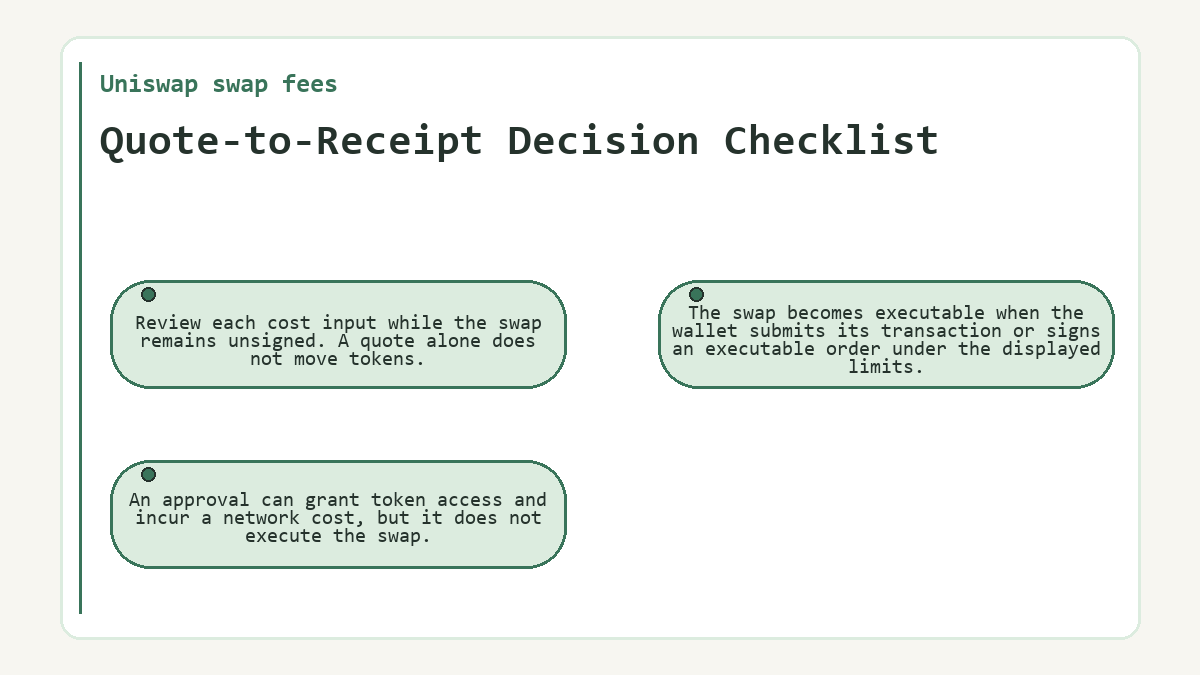
Review each cost input while the swap remains unsigned. A quote alone does not move tokens. An approval can grant token access and incur a network cost, but it does not execute the swap. The swap becomes executable when the wallet submits its transaction or signs an executable order under the displayed limits.
- Verify the selected network, token contracts, input balance, and native network balance before requesting the final quote.
- Record the input, quoted output, minimum output or maximum input, pool fee, price impact, route, and network estimate while the request remains unsigned.
- If an approval is required, review its spender and allowance separately, complete only the intended authorization, and obtain a fresh swap quote afterward.
- Authorize the exchange only while its output bound and separate charges remain acceptable, then retain the resulting transaction or order identifier.
- Confirm successful settlement and compare actual token movements, output received, and the recorded network charge with the saved quote.
Any change to the amount, route, fee setting, or pool state can produce a new cost basis. Treat a refreshed quote as a replacement for the earlier snapshot rather than combining values from both.
Receipt and Balance Reconciliation
A successful receipt establishes that the execution completed, but reconciliation still requires the resulting token movements. Compare the actual output with the quoted output and the signed minimum. Then record the network fee from the transaction record and include any earlier approval fee that belongs to the same exchange task. The pool fee will normally appear through the input-to-output calculation rather than as a separate wallet transfer.
Economic cost requires a consistent valuation basis. Value the input spent, output received, approval cost, and execution cost at the same reference time if they must be expressed in one unit. Mixing a historical quote with later portfolio prices turns market movement into an apparent fee. A difference between quoted and actual output can reflect execution within the accepted bound, while a failed receipt indicates that no token exchange settled. Use the receipt status and actual transfers, not the wallet’s estimated fiat display, to determine whether settlement succeeded.
Special Routes and Token-Level Charges
Special routes can shift who directly pays a network charge without removing its economic effect. On an eligible UniswapX swap, a filler pays most execution network costs and accounts for them in the offered price. The swapper may still incur a network cost for an initial onchain approval or for wrapping a native network asset before the order can execute.
A fee-on-transfer token applies its own contract-level charge when tokens move. That charge is separate from the pool fee and does not go to Uniswap liquidity providers. A Uniswap v4 hook can also implement custom fee logic alongside the pool’s swap fee, while an interface may disclose another explicit charge when applicable. Each visible charge belongs in the quote review and final reconciliation under its own label.
When a route class, dynamic fee, or token-level charge changes, refresh the quote before authorization. Use the final receipt and token output to reconcile the settled cost.
What readers ask about Uniswap swap fees
-
Will the v2 Protocol Fee Increase the trader’s 0.30% Swap Charge?
- No. Uniswap v2 keeps the trader’s pool swap fee at 0.30%. With the protocol fee active on v2 pools, 0.05% goes to the protocol and 0.25% goes to liquidity providers. It does not add another 0.05 percentage points to the trader’s pool fee. Network and token charges remain separate.
-
How Does a v4 Dynamic Fee Affect a Quote Saved Earlier?
- A saved quote can become stale because a v4 hook may update a dynamic fee before the swap executes. The new fee changes the route’s expected output and perhaps the preferred route. Refresh the quote after any delay, then review the new pool fee, output, minimum output, and network estimate before authorization.
-
Why Might Two Equal Swaps Show Different Network Estimates?
- Two equal inputs can require different pools, hops, or contract calls, and changing network demand affects processing prices. Equal trade values therefore do not imply identical execution work. Compare each network estimate alongside its route’s net output rather than treating one gas figure as a permanent property of the token pair.
-
Is Price Impact Paid to Liquidity Providers as a Fee?
- No. Price impact is the exchange-rate change caused by the trade’s interaction with available liquidity; it is not a transfer paid to liquidity providers. Liquidity providers earn the pool’s swap fee. Because both affect quoted output, comparing the net output prevents the same economic effect from being counted twice.
-
Is an Unused Token Approval Part of the swap’s Total Cost?
- Yes, if the approval supported that intended swap. An onchain approval consumes a network fee when confirmed even if the later swap never occurs. It does not charge a pool fee or exchange tokens, so keep the approval cost separate from swap execution when reconciling the full task.
-
What Happens to the Pool Fee When an Onchain Swap Reverts?
- A reverted pool swap rolls back token transfers and pool state, so it does not complete the exchange or collect the intended pool fee. The network can still charge for computation already performed. Use the receipt status to distinguish this outcome from a successful swap that delivered output within the accepted bounds.
-
Are fee-on-transfer Charges Included in Uniswap’s Pool Fee?
- No. A fee-on-transfer charge comes from the token contract’s rules and does not replace the pool fee. It can reduce the amount that reaches another part of the route or the wallet, and some token designs are incompatible with certain routers. Treat an explicit token charge or warning as a separate quote input.
-
Has Uniswap Labs Added an Interface Fee?
- No. The published Uniswap Labs policy states that, as of December 27, 2025, its interface and wallet charge no interface fee. That dated policy is separate from protocol pool fees, network costs, token charges, and route pricing. If a later quote shows an explicit interface fee, use that live quote for reconciliation.